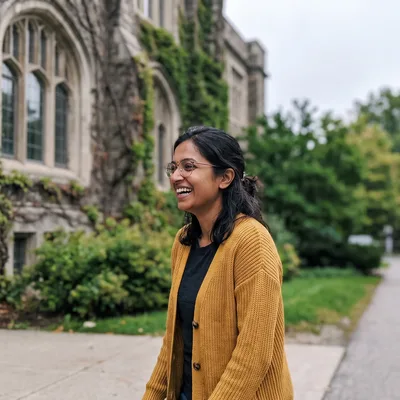
Summary
Computational biologist working at the interface of stochastic modelling and single-cell genomics. My research asks how individual cells commit to a fate, building probabilistic models that connect noisy single-cell measurements to tissue-scale behaviour. I am committed to reproducible, open science and to training the next generation of quantitative biologists.
Experience
Postdoctoral ResearcherStanford University
- Lead a project modelling gene-regulatory dynamics from single-cell time-series data across 1.2 million cells, integrating scRNA-seq with live-imaging trajectories.
- Developed a Bayesian state-space model that raised held-out cell-fate prediction accuracy from 71% to 89%.
- Maintain scdynamo, an open analysis pipeline adopted by four collaborating labs and cited in 12 downstream studies.
- Secured a 2-year Human Frontier Science Program grant as co-investigator with partner labs in Kyoto and Zurich.
- Mentor three PhD students and two rotation students, and co-supervise a summer undergraduate research programme.
Graduate ResearcherEMBL Heidelberg
- Developed inference methods for noisy live-imaging data, cutting parameter-estimation error by 40% over the prior standard.
- First-authored three peer-reviewed papers and presented at six international conferences.
- Built a Nextflow pipeline processing 8 TB of imaging data, reducing per-experiment analysis from days to hours.
- Co-organised the EMBL Computational Biology seminar series for two years.
Visiting Predoctoral FellowBroad Institute of MIT and Harvard
- Completed a six-month research visit applying optimal-transport methods to lineage-tracing data in a single-cell genomics group.
- Contributed the trajectory-alignment module that shipped in an open-source toolkit with over 900 GitHub stars.
Junior Research FellowIndian Institute of Science
- Modelled stochastic gene expression in bacterial populations, forming the basis of a first-author Physical Biology paper.
- Rewrote the lab's simulation code in Julia, running 15x faster than the previous MATLAB implementation.
Publications
Amortized Bayesian inference for gene-regulatory networks at scale
Stochastic models of cell-fate commitment in the early mammalian embryo
A benchmark of trajectory-inference methods for noisy single-cell time series
Reproducible single-cell pipelines: a practical guide
Inference of regulatory dynamics from live imaging of the Drosophila blastoderm
Projects
scdynamo
An open-source Python toolkit for inferring gene-regulatory dynamics from single-cell time series. Adopted by four labs, packaged on Bioconda, and used in a graduate course at Stanford.
PythonPyTorchNextflow
celltrace
A lightweight library for tracking and aligning cell lineages from live-imaging movies, with a napari plugin for interactive curation of noisy tracks.
PythonnapariOptimal transport
Awards
Human Frontier Science Program Young Investigator Grant (co-PI)Human Frontier Science Program
EMBO Postdoctoral FellowshipEuropean Molecular Biology Organization
Otto Schmitt Award for Best Thesis in Quantitative BiologyEMBL
Gates Cambridge ScholarshipUniversity of Cambridge
Education
University of CambridgePhD, Computational Biology
Indian Institute of ScienceMSc, Physics
Skills
Methods
Bayesian inferenceStochastic modellingSingle-cell analysisOptimal transportDynamical systemsStatistical genetics
Programming
PythonRJuliaC++Bash
Frameworks & Tools
PyTorchJAXNextflowSnakemakeScanpyGit
Communication
Scientific writingPeer reviewTeaching & mentoring
Languages
EnglishFluent
TamilNative
HindiProfessional working
GermanConversational